Warning: Array to string conversion in /home/www/www.sknl.cn/wp-content/plugins/wpjam-basic/public/wpjam-utils.php on line 496
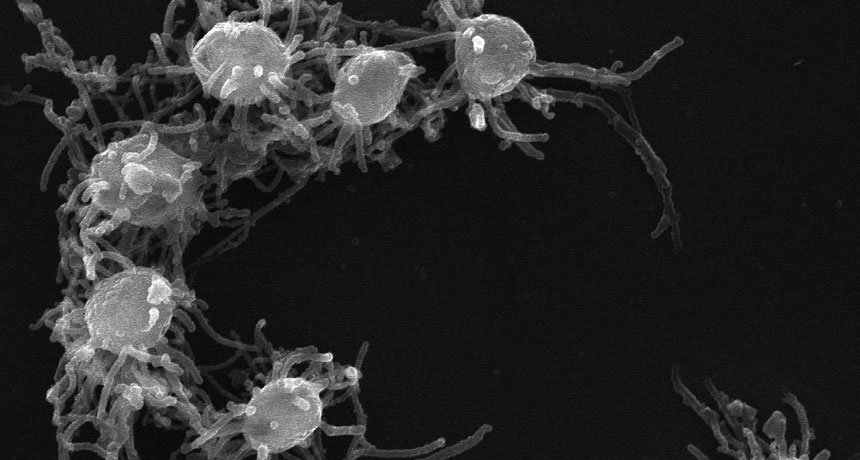
Scaling up from one cell to many may have been a small step rather than a giant leap for early life on Earth. A single-celled organism closely related to animals controls its life cycle using a molecular toolkit much like the one animals use to give their cells different roles, scientists report October 13 in Developmental Cell.
“Animals are regarded as this very special branch, as in, there had to be so many innovations to be an animal,” says David Booth, a biologist at the University of California, Berkeley who wasn’t part of the study. But this research shows “a lot of the machinery was there millions of years before animals evolved.”
Multicellular organisms need to be able to send messages between their cells and direct them to particular roles within the body. That requires a great deal of cell-to-cell coordination — something that unicellular organisms don’t have to deal with. But an amoeba (Capsaspora owczarzaki) employs many of those same tricks to switch its single-celled body between different life stages. That means that the earliest animals were probably “recycling mechanisms that were already present before,” says study coauthor Iñaki Ruiz-Trillo, a biologist at the Institute for Evolutionary Biology in Barcelona.
C. owczarzaki goes through three different life stages, acting independently in some stages and aggregating with other amoebas in others. Ruiz-Trillo and colleagues analyzed C. owczarzaki’s proteome — its complete set of proteins — during each life stage.
The amoeba made different amounts of its proteins in each life stage, the team found, suggesting that it was responding to new demands. But it went a step further, too, also shifting the way its proteins behaved during each stage.
Proteins can change their behavior by grabbing on to a molecular fragment called a phosphate ion. The phosphate ion’s effect depends on where it sticks to the protein and whether there are other phosphate ions stuck on nearby. C. owczarzaki showed distinct differences in the pattern of these phosphate add-ons between its three life stages. That parallels what’s seen in animals: Proteins in different organs within the same animal show similar modification differences.
The researchers also found changes in the molecules that control the protein modification process. Certain enzymes within a cell act like molecular concierges, helping phosphate ions latch on to proteins. The type of enzyme often determines where the ion sticks — and thus the effect it has. For instance, enzymes called tyrosine kinases often guide modifications that help multicellular organisms send messages between cells. Those enzymes aren’t thought to be widely used by single-celled species, says study coauthor Eduard Sabidó, a biologist at the Centre for Genomic Regulation in Barcelona. But C. owczarzaki uses these enzymes across all of its life stages, generating them in different quantities depending on the stage.
Previous research showed that other single-celled organisms had the genes for tyrosine signaling, but this study shows how widely it’s actually used and how closely it’s linked to specific life changes, says Booth.
The shared molecular mechanisms suggest that the unicellular common ancestor of today’s animals and C. owczarzaki probably used these same tricks, too, paving the way for multicellular life. That’s not to say animals don’t get any credit, says Sabidó — they’ve expanded this toolkit further over time. But the perceived chasm between a simple single-celled existence and a complex multicellular one might not have required a flying leap to cross. “This gap,” Sabidó says, “maybe isn’t such a gap.”
Array