Warning: Array to string conversion in /home/www/www.sknl.cn/wp-content/plugins/wpjam-basic/public/wpjam-utils.php on line 496
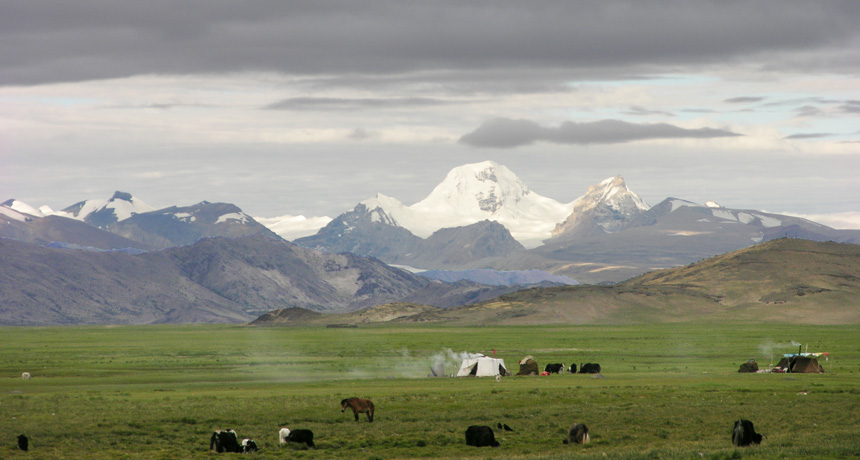
People hunted and foraged year-round in the thin air of China’s Tibetan Plateau at least 7,400 to 8,400 years ago, a new study suggests. And permanent settlers of the high-altitude region might even have arrived as early as 12,000 to 13,000 years ago.
Three lines of dating evidence indicate that humans occupied the central Tibetan Plateau’s Chusang site, located more than 4,000 meters above sea level, at least 2,200 years earlier than previously thought, say geologist Michael Meyer of the University of Innsbruck in Austria and colleagues. Their report, published in the Jan. 6 Science, challenges the idea that the Tibetan Plateau lacked permanent settlers until farming groups arrived around 5,200 years ago.、
“Hunter-gatherers permanently occupied the Tibetan Plateau by around 8,000 years ago, which coincided with a strong monsoon throughout Asia that created wet conditions on the plateau,” Meyer says.
These early permanent residents hunted animals such as wild yaks and foraged for edible plants, including berries from sea buckthorn shrubs, in nearby river valleys at elevations more than 3,600 meters above sea level, Meyer suspects. Brief, summer forays to Chusang would have been difficult for people living below 3,300 meters above sea level, he adds. Even when mountain passes were clear of heavy snowfall and expanding valley glaciers, round trips from low altitudes to the central Tibetan Plateau would have taken 41 to 70 days, Meyer’s team estimates.
Researchers discovered Chusang in 1998. The site consists of 19 human hand- and footprints on the surface of a fossilized sheet of travertine, a form of limestone deposited there by water from a hot spring.
The new age estimates for Chusang come from three measures: the decay rate of forms of radioactive thorium and uranium in travertine sampled in and around the prints; determinations of the time since quartz crystals extracted from the travertine were last exposed to sunlight; and radiocarbon measures of sediment and microscopic plant remains found on the travertine slab’s surface.
Signs of long-term camping at Chusang have yet to turn up, but extensive excavations of the site have not been conducted, Meyer says. His group found chipped rocks and other stone tool‒making debris at two spots near Chusang’s hot springs. These finds are undated.
Previous research has suggested that hunter-gatherers occasionally reached the Tibetan Plateau’s northern edge by around 12,000 years ago (SN: 7/7/01, p. 7), and again from about 8,000 to 6,000 years ago, says archaeologist Loukas Barton of the University of Pittsburgh, who wasn’t involved in the study. But the new discoveries at Chusang may not necessarily point to permanent residence there. Those early arrivals likely spent a single summer or a few consecutive years at most on the plateau, Barton says. “That would not constitute a peopling of a region any more than our 1969 visit to the moon did,” he says.
Archaeological finds indicate that human populations expanded on the Tibetan Plateau between around 5,200 and 3,600 years ago, Barton says. Those groups cultivated barley and wheat at high altitudes and herded domesticated sheep and perhaps yaks, he says.
Before that time, Chusang might have supported a year-round occupation, says archaeologist David Rhode of the Desert Research Institute in Reno, Nev., who wasn’t involved in the study. But the site could easily have been occupied seasonally, he says. Unlike Meyer, Rhode estimates that Chusang was about a two-week walk from some lower-altitude campsites. “That’s not far at all for a human forager.”
New dates for Chusang also raise the possibility that rare gene variants that aid survival in high-altitude, oxygen-poor locales first evolved among hunter-gatherers on the Tibetan Plateau, Meyer says. But both Barton and Rhode doubt it.
Array