Warning: Array to string conversion in /home/www/www.sknl.cn/wp-content/plugins/wpjam-basic/public/wpjam-utils.php on line 496
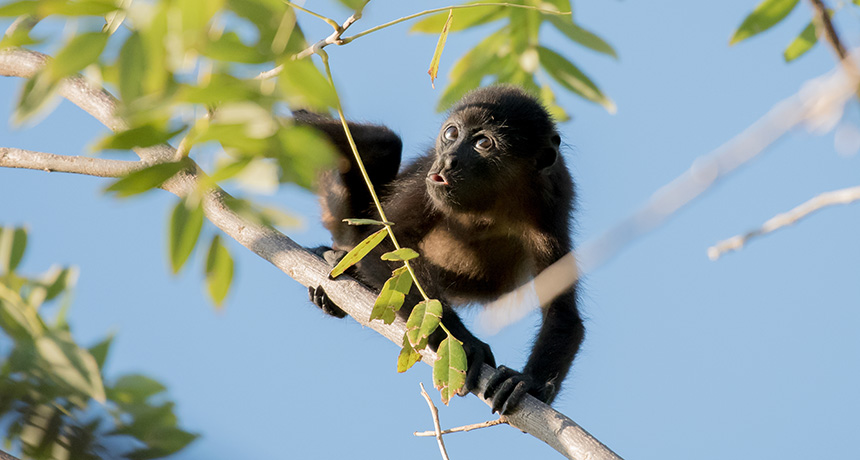
BOSTON — A taste for reddish young leaves might have pushed howler monkeys toward full-spectrum color vision. The ability to tell red from green could have helped howlers pick out the more nutritious, younger leaves, researchers reported February 19 at the annual meeting of the American Association for the Advancement of Science. That’s a skill their insect-eating close relatives probably didn’t need.
Primates show substantial variation in their color vision capabilities, both between and within species, said Amanda Melin, a biological anthropologist at the University of Calgary in Canada. Trichromatic vision (how most humans see) requires three light-sensitive proteins in the eye that can detect different wavelengths of light. Within most monkey species in Central and South America, only some individuals have trichromatic vision. Males have dichromatic vision — they’re red-green colorblind — and only some females can see the whole rainbow. Howlers are an exception — thanks to a duplicated gene on their X chromosomes, trichromatic vision is the norm for both males and females.
Howlers graze on leaves from Ficus trees and other plants when fruit can’t be found. In field observations of mantled howlers (Alouatta palliata) in Costa Rica, the monkeys preferentially munched on the younger, more nutritious leaves, Melin’s team found. The reddish hue of new leaves makes them pop more when seen with trichromatic vision than dichromatic vision, the researchers reported in a paper accepted for publication in Ecology and Evolution. Because young leaves are a fleeting treat and not a constant resource, monkeys able to spot them more quickly could have had a selective advantage.
Similar selection pressures might also help explain why Old World monkeys from Asia and Africa also have consistent trichromatic vision, Melin said. “What we might be seeing is a convergent evolution for animals who fall back on leaves when fruit isn’t around.”
On the other hand, other Central and South American monkeys usually go for insects, instead of leaves, when there’s no fruit. Dichromatic vision might be a better fit for their lifestyle, Melin said. “Color can impede ability to see patterns, borders and textures. Insects hide and camouflage.”
Array