Warning: Array to string conversion in /home/www/www.sknl.cn/wp-content/plugins/wpjam-basic/public/wpjam-utils.php on line 496
Nomadic warriors and herders known as the Huns are described in historical accounts as having instigated the fifth century fall of the Roman Empire under Attila’s leadership. But the invaders weren’t always so fierce. Sometimes they shared rather than fought with the Romans, new evidence suggests.
Huns and farmers living around the Roman Empire’s eastern border, where the Danube River runs through present-day Hungary, borrowed ways of life from each other during the fifth century, say archaeologist Susanne Hakenbeck of the University of Cambridge and colleagues. Nomadic Huns on the Roman frontier raised relatively small numbers of animals and grew some crops, while border-zone farmers incorporated more meat into what had been a wheat- and vegetable-heavy diet, the scientists report March 22 in PLOS ONE.
“Our data show that the dietary strategies of the people on both sides of the Roman frontier were not fundamentally different,” Hakenbeck says.
Their findings challenge a traditional view of the Huns as marauders who roamed hundreds of kilometers from Central Asia to Europe. There’s no evidence of major social upheavals or a geographically distinctive group of newcomers at the frontier sites, so at least some Huns may have been homegrown, Hakenbeck suggests. Rapidly forming groups of Hun warriors and herders on horseback could have emerged in southeastern Europe not far from the Roman Empire’s border, perhaps supplemented by nomadic newcomers from farther east near the Black Sea, she proposes.
Still, geographic origins of the Huns are tough to pin down, says archaeologist Ursula Brosseder of the University of Bonn in Germany. The Huns developed as a political movement that picked up members from various ethnic groups as it spread, she explains. Brosseder suspects the “Hun phenomenon” formed on the grasslands of Western Eurasia, a territory that includes regions cited by Hakenbeck. The earliest evidence of Huns in that region dates to about 2,400 years ago.
The new study supports the idea that herding communities adapted flexibly to new environments, sometimes relying only on their livestock and at other times farming to varying extents, Brosseder says. Nomadic herders in Asia probably cultivated millet, a fast-growing cereal that can be used to feed people and horses, Hakenbeck says.
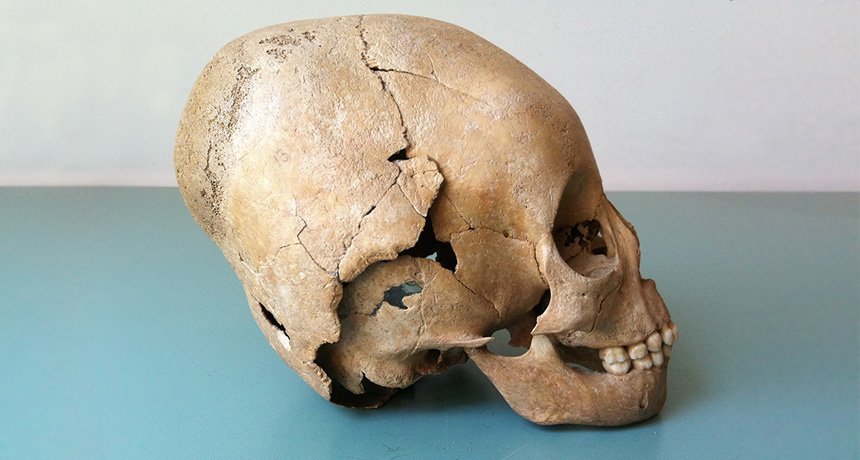
Her group studied skeletons of 234 people buried at five previously excavated sites on or near the Roman frontier. Each site contained evidence of contact with Huns, including bronze artifacts and adult skulls with elongated braincases created by binding the head during childhood. Reasons for this practice are poorly understood. It may have signified affiliation with the Huns or social status of some kind.
Graves at a Roman fort and a nearby cemetery lay on Roman land, about 150 kilometers from the frontier. Another two cemeteries were situated on the banks of the Danube River, directly on the Roman frontier. A final graveyard fell outside Roman territory. It was located about 150 kilometers east of the border.
Measurements of ratios of specific forms of carbon, nitrogen and oxygen in teeth and ribs enabled the scientists to identify what types of plants and how much meat or milk individuals ate during childhood, early adulthood and toward the end of their lives.
Results pointed to considerable consumption of cultivated plants, most likely millet, as well as meat or milk at all five sites. Variations on this general pattern occurred across sites and among individuals at each site, suggesting that groups and individuals rapidly adjusted how much they farmed or herded as circumstances dictated. “This mixing and matching was likely a kind of economic insurance policy in violent and unstable times,” Hakenbeck says.
Hakenbeck’s group also measured another tooth element, strontium, to determine whether individuals at four of the sites had grown up drinking water and eating food in the locales where they were buried. Between 30 and 50 percent of individuals studied at those sites weren’t locals, and the birthplaces of these people remain a mystery, Hakenbeck says.
In many cases, both newcomers and natives to the Roman frontier substantially changed their eating habits over the course of their lives, the researchers find. That fits Hakenbeck’s “mix and match” scenario, in which a fluctuating diet aided survival on the empire’s edge.
Array