Warning: Array to string conversion in /home/www/www.sknl.cn/wp-content/plugins/wpjam-basic/public/wpjam-utils.php on line 496
The battle over the heft of a hard-to-detect particle is heating up. What’s at stake? Only the leading theory describing all known matter in the universe.
A recalculation of the mass of an elementary particle, the W boson, has increased the tension between measurements from competing particle collider experiments. The ultimate outcome could bolster the standard model of particle physics, which describes the fundamental forces and quantum bits that make up everything we see in the cosmos. Or it could reveal signs of the standard model’s breakdown, depending on which lab’s answer prevails.
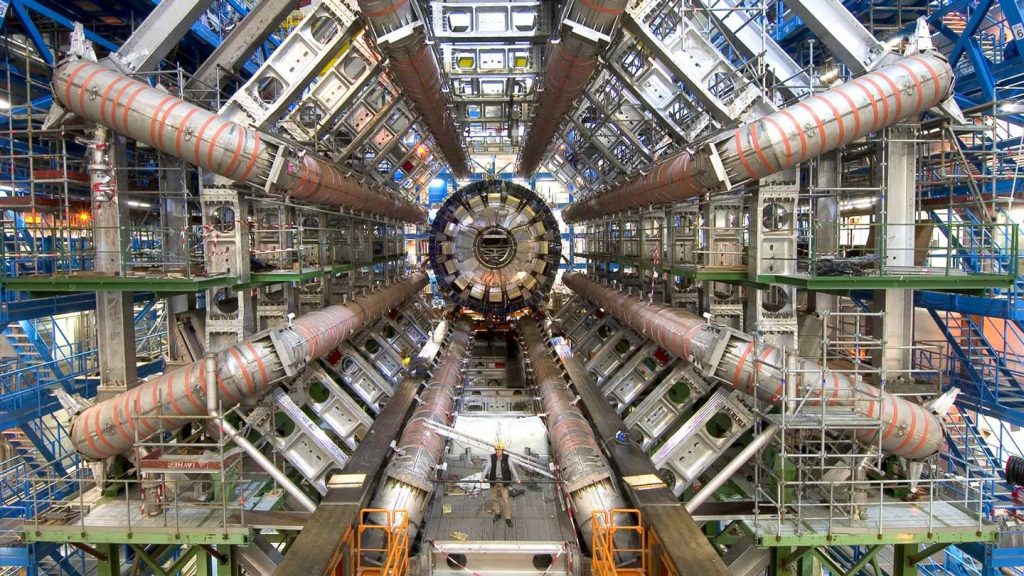
A reanalysis of old data from the Large Hadron Collider’s ATLAS experiment yields a W boson mass of about 80,360 million electron volts, or MeV. Researchers with the experiment, at CERN in Geneva, reported the measurement March 23 at the Rencontres de Moriond conference in La Thuile, Italy. The revised value is closely aligned with predictions from the standard model.
It also boasts reduced uncertainty from the researchers’ previous analysis of the data, which they reported in 2018, increasing their confidence that they got the mass right.
But the updated mass is at odds with that of another group. In 2022, scientists from the Collider Detector at Fermilab, or CDF, experiment shocked the physics community with a measurement of 80,434 MeV — about 100 MeV heavier than expected (SN: 4/7/22). If the CDF report is correct, it implies that something is off with the standard model that has persevered in the face of every experimental challenge thrown at it over the last 50 years.
The W boson is responsible for the weak force, one of three fundamental forces in the standard model (SN: 2/5/83). And “it’s the only mass of a particle in the standard model that can be calculated,” says theoretical physicist Sven Heinemeyer of the Karlsruhe Institute of Technology in Germany. That is, the standard model theory yields a specific mass for the W boson, whereas the masses of other particles such as electrons and quarks are inputs and can be — as far as the theory is concerned — any value. Finding a W boson mass that’s different from standard model predictions would show the current theory is wrong.
The ATLAS reanalysis offers a stronger counterpoint to the CDF claim than the earlier ATLAS analysis of the same data. “The new analysis is an important confirmation of our previous result,” says Andreas Hoecker, a physicist at CERN.
The latest ATLAS value widens the chasm that separates CDF’s mass measurement from the herd of other studies. But it shouldn’t be seen as erasing CDF’s standard model challenge, says Duke University physicist Ashutosh Kotwal, a member of the CDF collaboration.
“The perspective on the CDF [announcement of a heavy W boson in 2022] does not change because of the ATLAS reanalysis,” Kotwal says. Because the reanalysis is based on data that ATLAS already released in 2017, he says, “the fact that ATLAS obtains a similar value as before is to be expected.”
Heinemeyer, who is not affiliated with ATLAS or CDF, sees a shift in the W boson mass landscape, but no sign of a resolution of the discrepancy.
“Having one new measurement is not enough,” Heinemeyer says. “If more and more measurements were to come out now from ATLAS and [other experiments], and they would all be in the same ballpark, at some point the community would decide CDF did something wrong.”
The next word on the W boson mass will probably come with pending studies from ATLAS and other experiments at CERN. The CDF experiment shut down in 2011, so it will not contribute further to the debate.
In the meantime, researchers hope to scrutinize each other’s analyses to search for clues that might help explain discrepancies in W boson mass measurements. “The CDF April 2022 paper provides a number of cross-checks of the CDF methodology and is transparent,” Kotwal says. “I look forward to detailed discussions of the ATLAS methodology.”
In the end, the conflict might reveal a new crack in the standard model. Or it could turn out to be another example of one of the most successful theories in history standing strong.
Array