China conducts fisheries resource survey in waters east of Taiwan island as way to counter Japan‑Philippine claims: experts
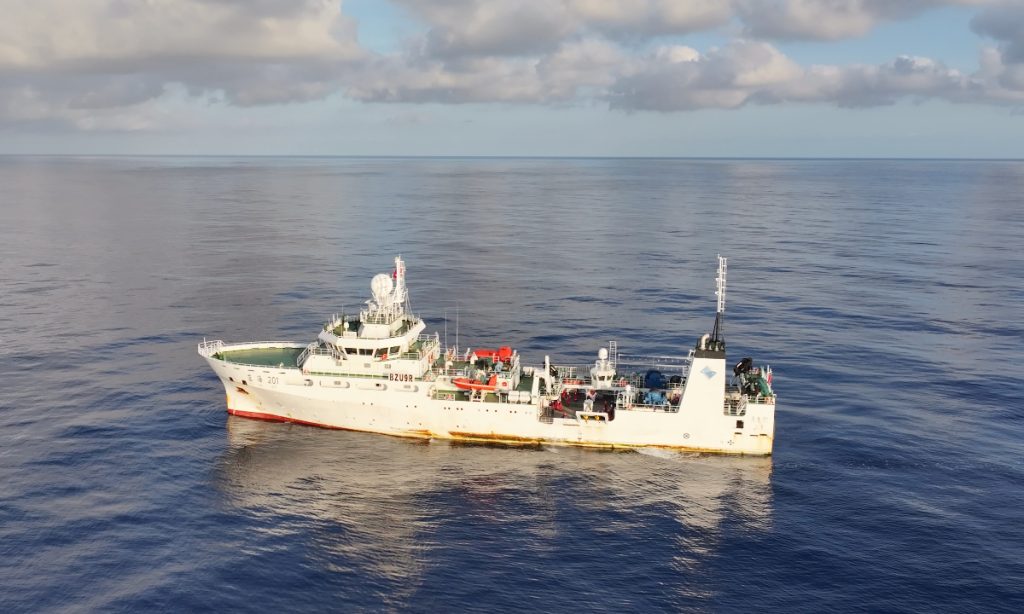
To gain a comprehensive understanding of fishery resources in China's jurisdictional waters and support the conservation and sustainable development of marine fishery resources, the Lanhai (Blue Ocean) 201 scientific survey vessel operated by the East China Sea Fisheries Research Institute under the Chinese Academy of Fishery Sciences conducted a fishery resources survey in waters east of China's Taiwan island from July 17 to 23, China Central Television (CCTV) News reported on Thursday, citing the Ministry of Agriculture and Rural Affairs.
According to a statement released by the ministry, the waters east of Taiwan island are rich in fishery resources and serve as important spawning grounds for major commercial species such as tuna.
Using multidisciplinary methods, researchers collected biological samples of fish, cephalopods, crustaceans and other fishery organisms, as well as environmental DNA samples. They also gathered basic data on fisheries acoustics, hydrology, meteorology, and other related factors.
The findings are expected to lay a foundation for a systematic understanding of fishery resources in the region and provide scientific support for fisheries conservation, management, and the sustainable development of marine fisheries.
Since the waters provide important spawning grounds for cephalopods and tuna species, the survey also helps better understand the life cycles of key fishery resources, Chen Xinjun, a professor from Shanghai Ocean University, told the Global Times on Thursday.
The Lanhai 201 survey vessel is owned and operated by the East China Sea Fisheries Research Institute of the Chinese Academy of Fishery Sciences, an affiliate of the Ministry of Agriculture and Rural Affairs. According to the institute, it is the largest, most advanced, and most heavily invested fisheries research vessel of its kind under the ministry.
Equipped with internationally advanced technologies, the survey vessel is an important component of China's national fisheries scientific research vessel system and serves as a flagship platform for marine fisheries science and agricultural modernization, according to the institute.
Weighing 3,289 tons and measuring 84.5 meters in length, the vessel has a cruising range of 10,000 nautical miles and global navigation capabilities (outside of polar ice regions), according to the institute.
Previously, China's Ministry of Natural Resources conducted more geological, oceanographic, and hydrological surveys in these waters, while fisheries resource surveys were relatively limited due to fewer dedicated fisheries research vessels, Chen said, adding that therefore one major goal of this survey, similar to the scientific survey vessels, is to establish a comprehensive fisheries resource monitoring system.
In addition to assessing local fishery stocks, Chinese experts noted that since conducting a fisheries resource survey in waters east of Taiwan island first requires having jurisdiction over the area, the survey not only underscores China's sovereignty claims over the waters, but also serves as a countermeasure against maritime boundary delimitation talks by Japan and the Philippines.
Carrying out fisheries resource surveys in waters east of Taiwan asserts China's jurisdiction over these waters, since resource surveys can only be conducted on the premise of holding jurisdiction over relevant maritime areas, Tang Yi, a professor from Shanghai Ocean University, told the Global Times on Thursday.
"If any state intends to conduct fisheries resource surveys within another country's exclusive economic zone, it must notify the relevant coastal state six months in advance and secure prior approval before carrying out such activities," Tang said, noting that this survey also serves as a countermeasure to the maritime boundary delimitation talks launched by Japan and the Philippines in waters east of China's Taiwan island, demonstrating that their delimitation claims are invalid.
In response to an inquiry regarding a joint statement issued by Japan and the Philippines claiming that the two sides decided to "commence formal negotiations to delimit the maritime boundary of the exclusive economic zone and the continental shelf between the two countries," Chinese Foreign Ministry Mao Ning said on May 29 that in accordance with China's domestic laws and international law including the United Nations Convention on the Law of the Sea, China enjoys exclusive economic zone and continental shelf rights in the relevant waters.
China solemnly states that the "negotiations to delimit the maritime boundary" between Japan and the Philippines are completely illegal and null and void, and will in no way affect China's maritime claims and the exercise of its legitimate rights and interests in the waters east of Taiwan island, Mao said.
China urges Japan and the Philippines to immediately cease any acts that undermine China's maritime rights and interests, and take concrete actions to safeguard regional peace and stability, the spokesperson said.