Warning: Array to string conversion in /home/www/www.sknl.cn/wp-content/plugins/wpjam-basic/public/wpjam-utils.php on line 496
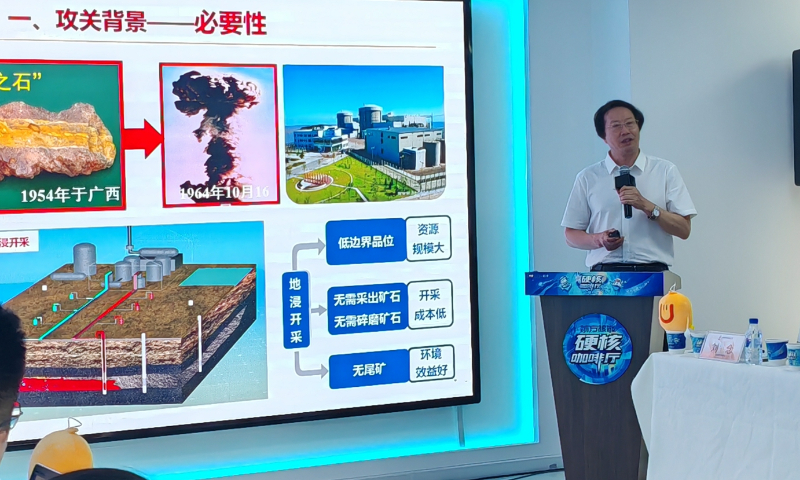
A team of Chinese experts discovered the world's deepest sandstone-type industrial uranium mineralization at a depth of 1,820 meters in the Tarim Basin in Northwest China's Xinjiang Uygur Autonomous Region, and this breakthrough set a new global record for the deepest discovery of sandstone-type industrial uranium mineralization, marking China's leading position globally in the exploration of deep-earth sandstone-type uranium resource and providing new theoretical support and innovative prospecting approaches for global uranium resource exploration, said the China Atomic Energy Authority (CAEA) on Friday.
The uranium exploration aims to discover and confirm deposits with industrial value while evaluating their resource potential and development prospects. Industrial uranium mineralization serves as a direct and reliable indicator for locating industrial-grade uranium deposits, according to the CAEA.
This newly discovered industrial uranium mineralization is the first major thick-bedded mineralization found in the red variegated strata of the uninhabited hinterland of the Tarim Basin, filling a significant prospecting gap in China's largest desert-covered region, according to the CAEA.
"Not only did we discover the uranium, but we also established a technological system for sandstone uranium exploration applicable to desert regions worldwide," Qin Mingkuan, chief scientist at the China National Nuclear Corporation and a leader of a scientific research team for nuclear energy development in the Tarim Basin, told the Global Times.
"In the Tarim Basin, the exploration team faced challenges such as harsh terrain, inherently poor construction conditions, limited technical capabilities of uranium detection equipment, and the absence of successful domestic or international precedents to draw from. Therefore, the key to our success lay in breaking with tradition and adopting an innovative shift in thinking," Qin said.
In 2020, while reviewing 30 years of exploration data, Qin and his team noticed radioactive anomalies in red beds far from the basin's edge. He realized that the widely distributed red variegated strata in the main basin area could indeed form ore deposits under specific conditions, then shifted the focus to the main basin's "variegated red" new strata and the "desert hinterland of the basin" - areas long considered no-go zones for mineral exploration.
Guided by this approach, the team conducted multiple field surveys, innovatively proposed the "exfiltration-infiltration composite genetic regional prediction model," advanced sandstone-type uranium metallogenic theory, and developed efficient deep drilling technology for complex strata in the Tarim Basin, providing strong support for this breakthrough in sandstone-type industrial uranium mineralization prospecting, Qin said.
This signifies that China has overcome the theoretical barriers of sandstone-type uranium metallogeny and, based on "satellite remote sensing - aerial survey - ground detection - deep exploration" 3D detection technologies, has established an integrated green and efficient prospecting system for sandstone-type uranium deposits in desert-covered areas. This achievement represents a breakthrough in new regions, new strata, new types, and new depths, serving as a model for sandstone-type uranium exploration in China, according to the CAEA.
Regarding the next steps, Qin said the Tarim Basin remains a key target for their scientific and technological breakthroughs.
"The current discoveries will help advance the identification of deposits, but there is still a long way to go before actual extraction, which requires detailed exploration and multiple additional steps," Qin said. "Though the path may be winding, the future is undoubtedly bright."
Array