Warning: Array to string conversion in /home/www/www.sknl.cn/wp-content/plugins/wpjam-basic/public/wpjam-utils.php on line 496
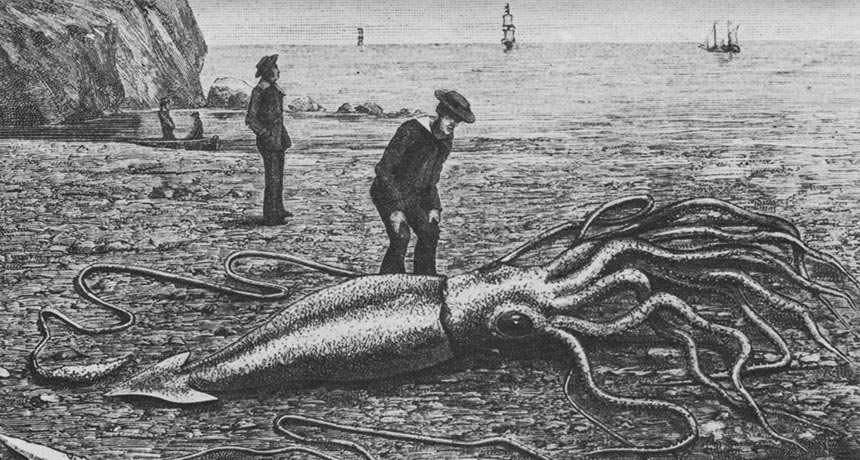
Giant squid are the stuff of nightmares. They were even one of the deadly dangers in Jules Verne’s 20,000 Leagues Under the Sea, attacking the Nautilus in a group and carrying off one of the crew:
Just as we were crowding each other to reach the platform, two more arms lashed the air, swooped on the seaman stationed in front of Captain Nemo, and carried the fellow away with irresistible violence…. What a scene! Seized by the tentacle and glued to its suckers, the unfortunate man was swinging in the air at the mercy of this enormous appendage. He gasped, he choked, he yelled: ‘Help! Help!’ … The poor fellow was done for.
What makes Verne’s giant squid all the more frightening is that he didn’t invent the creatures; giant squid strandings had been documented in Europe since at least 1639, and scientists informally described the animals in the late 1850s.
But even if we don’t really have to worry about the huge invertebrates snatching people off boats, giant squid remain mysterious. They weren’t even photographed in the wild until 2004. And many questions remain unanswered about them. The biggest: Just how giant can the giants get? A new study has come up with an estimate — and also highlights the many reasons why it’s so difficult to come up with one.
Charles Paxton of the University of St. Andrews in Scotland starts by laying out five ways that it should be possible to estimate squid length, and why the first four aren’t great measures. Anecdotal accounts — which claim giant squid reaching lengths of 30 meters and 53 meters, not counting the two long tentacles — are often riddled with inaccuracy and exaggeration. Estimating maximum length based on squid growth rate won’t work because squid growth rates just aren’t well known. Some scientists have tried to determine lengths based on the sucker scars found on whales, but since scientists don’t know how whale growth affects the sizes of those scars, those aren’t a good measure either.
Direct measurement of dead squid would seem to be a good option, except that the two long tentacles of a squid — which extend far beyond the animal’s arms and determine its full length — are elastic and can change in length when a squid is preserved, Paxton notes. That leaves the fifth method — estimating length based on the size of the hard beak. Beak size and squid body length are related.
Paxton combined the last two methods to come up with a maximum length for a giant squid of about 20 meters, from the top of its mantle, or body, to the tip of its long tentacles. His estimate appears May 17 in the Journal of Zoology.
The longest squid ever reported was 17.37 meters long, and Paxton questions its veracity, as does another paper published last year in PeerJ. Craig McClain of Duke University and colleagues note that the “longest scientifically verified giant squid” measured a mere 12 meters. “What limits the large size of [giant squid] is unclear,” McClain and colleagues write. But metabolic demands may play a role, keeping squid from getting much bigger than what have washed up onto shore (and also keeping them in the cold depths where they’re so difficult for us to find).
But perhaps the focus on the largest and biggest of species is the wrong approach, McClain and his colleagues argue (in, ironically, a paper all about large marine species). The longest, most giant individuals are, after all, just a tiny fraction of a species — and, these researchers write, “these individuals may reach these extraordinary large sizes through developmental or genetic defects and may not represent the healthiest or, in evolutionary terms, the fittest.”
They are, though, among the most mysterious creatures to inhabit our planet.
Array