Warning: Array to string conversion in /home/www/www.sknl.cn/wp-content/plugins/wpjam-basic/public/wpjam-utils.php on line 496
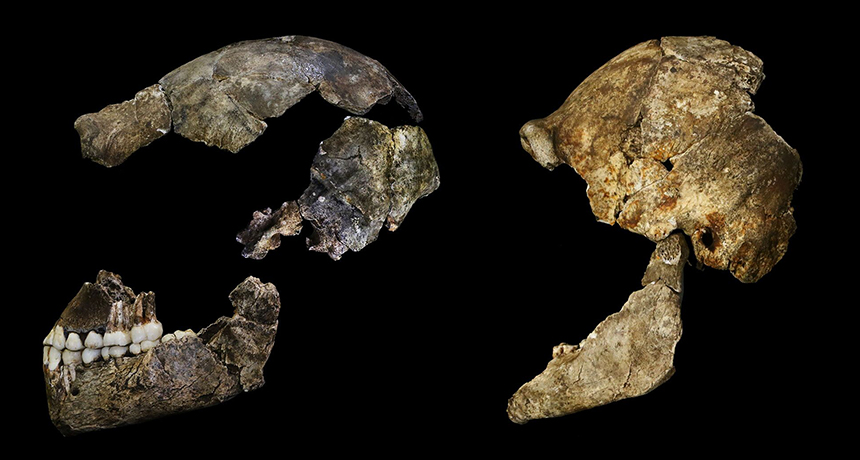
Homo naledi, currently the best-known and most mysterious fossil species in the human genus, may be considerably younger than previously thought, a new investigation suggests.
Evolutionary trees of ancient hominids statistically reconstructed from skull and tooth measurements indicate that H. naledi lived around 912,000 years ago, say paleoanthropologist Mana Dembo of Simon Fraser University in Burnaby, Canada, and her colleagues. That’s a provisional estimate, since researchers have yet to date either H. naledi’s bones or the sediment in which some of its remains were excavated.
The new statistical age estimate, described by Dembo’s group in the August Journal of Human Evolution, challenges proposals that H. naledi’s remains come from early in Homo evolution. Researchers who first studied H. naledi bones retrieved from an underground cave in South Africa noted similarities of the skull and several other body parts to early Homo species dating to between 2.5 million and 1.5 million years ago (SN: 10/3/15, p. 6).
A comparison of H. naledi skull measurements to those of 10 other hominid species, conducted by paleoanthropologist J. Francis Thackeray of the University of the Witwatersrand in Johannesburg, reached the same conclusion. H. naledi lived roughly 2 million years ago, Thackeray proposed in the November/December 2015 South African Journal of Science.
Dembo disagrees. Her team tested which of 60,000 possible evolutionary trees best fit skull and tooth measurements of H. naledi, 20 other hominid species, gorillas and chimpanzees. The new analysis keeps H. naledi in the genus Homo. But it’s still unclear which of several hominid species — including Homo sapiens, Homo floresiensis (or “hobbits”) and Australopithecus sediba (SN: 8/10/13, p. 26) — is most closely related to the South African species.
Dembo’s team found no signs that bones assigned to H. naledi represent a variant of Homo erectus, as some scientists have argued. H. erectus originated about 1.8 million years ago in Africa and rapidly spread to West Asia. But Dembo’s statistical model assumes that H. erectus skulls and teeth vary in shape throughout Africa and Asia much less than they actually do, says paleoanthropologist Christoph Zollikofer of the University of Zurich. Bones assigned to H. naledi most likely represent a form of H. erectus, he argues.
Further statistical comparisons that include measurements of limb and trunk bones may help to clarify H. naledi’s evolutionary relationships, Dembo says.
Based on geological dates for all hominids except H. naledi, the researchers also calculated the rate at which each species’ skull and tooth features evolved over time. Those results enabled the researchers to estimate H. naledi’s age.
“Homo naledi might be less than a million years old,” Dembo says. She considers that estimate “reasonably robust,” since ages calculated for other hominids in the analysis often fell close to dates gleaned from fossil and sediment studies. In a few cases, though, statistical and geological age estimates differed by 800,000 years or more.
A relatively young age for H. naledi expands the number of Homo species that survived well into the Stone Age, Dembo says. Small-brained H. naledi would have existed at the same time as larger-brained Homo species in Africa, just as small-brained H. floresiensis lived at the same time as larger-brained H. sapiens and H. erectus in Southeast Asia (SN: 7/9/16, p. 6).
If that scenario holds up, H. naledi may have made roughly 1-million-year-old stone tools that have been found in southern Africa, Dembo says.
“A young date for Homo naledi shouldn’t be unexpected,” says paleoanthropologist Matthew Tocheri of Lakehead University in Thunder Bay, Canada. At least some H. naledi bones appear not to have fossilized, he notes, consistent with a more recent age.
While Dembo’s statistical approach to hominid evolution shows promise, “a good geological date for H. naledi will trump the new date,” Tocheri adds.
Paleoanthropologist Bernard Wood of George Washington University in Washington, D.C., doesn’t think Dembo’s approach can accurately date H. naledi. But humanlike hands, feet and teeth of the South African hominid support the possibility that it lived about 1 million years ago, Wood says.
Two H. naledi researchers — John Hawks of the University of Wisconsin–Madison and Witwatersrand’s Lee Berger — still suspect the South African species lived at least 1.8 million years ago, based on its skeletal similarities to H. erectus. But a possible age of about 900,000 years for the cave finds, as proposed by Dembo, would be consistent with H. naledi or closely related species having survived in Africa for a million years or more, Hawks and Berger write in the current Transactions of the Royal Society of South Africa.
Array