Warning: Array to string conversion in /home/www/www.sknl.cn/wp-content/plugins/wpjam-basic/public/wpjam-utils.php on line 496
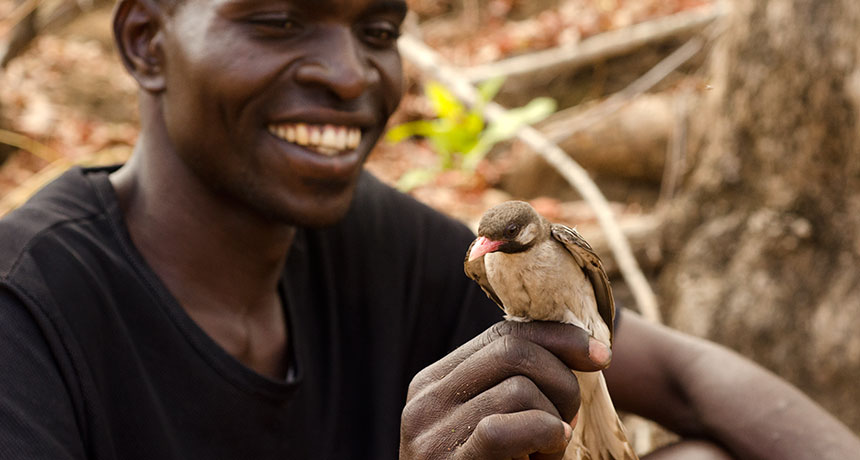
When asked the right way, a savvy bird species steers African hunter-gatherers to honey. All it takes is a loud trill followed by a grunt that sounds like “brrr-hm.”
Birds known as greater honeyguides (Indicator indicator) lead hunter-gatherers in Mozambique to honey-rich bees’ nests after hearing humans make this signature call, say evolutionary ecologist Claire Spottiswoode of the University of Cambridge and her colleagues. In exchange, the birds get human-aided access to perilous-to-reach food, the scientists report in the July 22 Science.
The new study provides the first solid evidence of two-way, collaborative communication between humans and a nonhuman animal in the wild. In some parts of the world, dolphins help fishermen herd fish into nets. But it’s unclear whether these dolphins respond to specific calls from fishermen.
Honeyguides associate Yao hunter-gatherers’ distinctive honey-hunting call with successful joint food hunts, Spottiswoode says. The birds respond to this call by making a loud chattering sound to alert humans to their presence. Honeyguides then fly from tree to tree until reaching one with a bees’ nest.
Although the wax-eating birds regularly scope out locations of bees’ nests in their home ranges, getting beeswax out of nests is dangerous. “Angry bees can and do sting honeyguides to death,” Spottiswoode says.
Yao honey hunters cut down trees containing bees’ nests nestled high up in crevices and smoke the insects out with flaming bundles of twigs and leaves. After removing honeycombs from nests, the Yao leave beeswax behind for their avian helpers and even put wax chunks on beds of leaves to reward honeyguides.
Written accounts of honeyguide-led expeditions to bees’ nests date to as early as 1588. But ax-like stone implements and human-made fires date to 1 million years ago or more (SN: 7/9/16, p. 10). So humans and honeyguides may have hunted together for at least that long, says Harvard University biological anthropologist Richard Wrangham.
In different parts of Africa, honeyguides respond to local honey-hunting calls of human groups, Spottiswoode suspects. A team led by Yale University biological anthropologist Brian Wood has found that Hadza honey hunters in Tanzania make a whistling sound to attract honeyguides. Other hunter-gatherers speak or shout words to call honeyguides, Wood says.
Unlike Yao honey hunters, the Hadza bury or burn much of the wax in bees’ nests. Hadza honey seekers believe this keeps honeyguides hungry and motivates them to lead further hunts. Wood’s team estimates that 8 to 10 percent of the Hadza’s diet comes from honeyguide-led hunts.
The new study “carefully documents one cultural tradition in how people and honeyguides interact,” Wood says.
Spottiswoode’s group conducted fieldwork in October 2013 and September and October 2015. The researchers tracked movements of six honeyguides fitted with radio transmitters. Overall, 73 of 97 bird-led honey hunts found at least one bees’ nest. During the study, nearly three-quarters of 149 bees’ nests found by the Yao involved honeyguide assistance.
In another experiment, Spottiswoode accompanied two Yao honey hunters on 72 searches for bees’ nests, each lasting 15 minutes. While they walked, a portable speaker played recordings every seven seconds either of a Yao honey hunter making the “brrr-hm” sound, a Yao individual saying words such as “honeyguide” or their own name, or a ring-necked dove’s song or excitement call.
Honeyguides joined 30 experimental searches. About two-thirds of searches that featured “brrr-hm” calls drew honeyguides’ assistance (although they did not always locate a bees’ nest). One-quarter of hunts that used recordings of words and one-third of those that played dove sounds received honeyguides’ help.
Spottiswoode’s team calculates that honey hunters who played the “brrr-hm” sound more than tripled their chances of actually finding a bees’ nest during 15-minute searches, compared with honey hunters who played Yao words or dove sounds.
Spottiswoode and Wood plan to investigate whether young honeyguides learn from adult birds to pay attention to humans’ honey-hunting calls and to lead humans to bees’ nests.
Array