Warning: Array to string conversion in /home/www/www.sknl.cn/wp-content/plugins/wpjam-basic/public/wpjam-utils.php on line 496
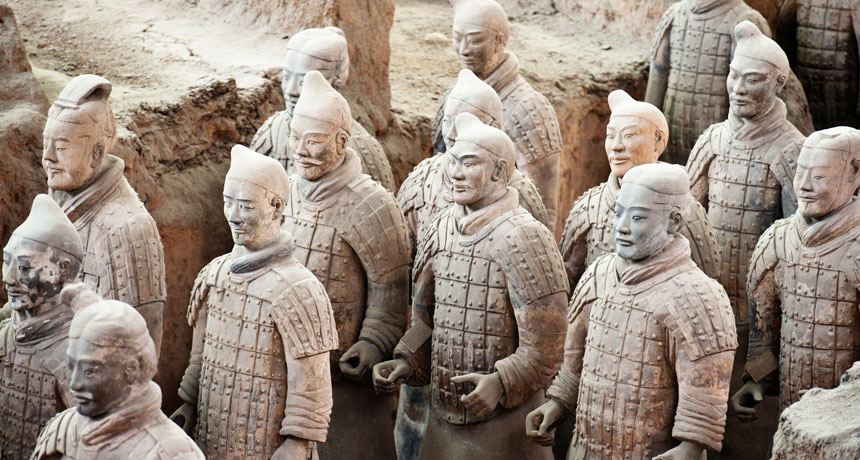
China’s first emperor broke the mold when he had himself buried with a terra-cotta army. Now insight into the careful crafting of those soldiers is coming from the clays used to build them. Custom clay pastes were mixed at a clay-making center and then distributed to specialized workshops that cranked out thousands of the life-size figures, new research suggests.
Roughly 700,000 craftsmen and laborers built Emperor Qin Shihuang’s palatial mausoleum in east-central China between 247 B.C. and 210 B.C. A portion of those workers gathered clay from nearby deposits and prepared it in at least three forms, researchers propose in the August Antiquity. On-site or nearby workshops used different signature clay recipes for terra-cotta warriors, parts of mostly bronze waterfowl figures and paving bricks for pits in which the soldiers originally stood.
Around 7,000 ceramic foot soldiers, generals and horses — equipped with a variety of bronze weapons — make up the army, which was accidentally discovered in 1974 by farmers digging a well. The emperor would have regarded the ceramic statues as a magic army that would protect him as he ruled in the afterlife, many researchers suspect.
Building and assembling the multitude was an enormous task. Workers poured clay mixtures into casts of torsos, limbs and other body parts, and then assembled the bodies, taking care to create different facial features for each soldier. Finished statues, now mostly gray, were covered in colored lacquers and likely fired in kilns. Most figures were placed inside one giant pit. Earthen walls formed 11 parallel corridors where statues stood in battle-ready rows.
Still, no workshops or debris firmly linked to the statue-making process have been found. As a result, the number, size, location and organization of workshops involved in producing the emperor’s ceramic troops remain uncertain.
Archaeologist Patrick Quinn of University College London and three Chinese colleagues studied the composition of clay samples from the site. The pieces were taken from 12 terra-cotta warriors, two acrobat statues found in a second pit, five clay bricks from the floor of the largest pit, clay fragments from inside three bronze waterfowl statues found in a third pit and part of an earthen wall in the acrobat pit.
Microscopic analysis of the samples revealed that the clay came from deposits near the tomb’s location, the scientists say. But the recipes for different parts varied. Paving bricks contained only a mixture of dark and light clays, while the clay used for warriors and acrobats had sand worked in. Sand and plant fragments were folded into a clay mixture that formed the core of the bronze waterfowl.
Sand may have made the clay more malleable for shaping into ornate figures and increased statues’ durability, the researchers speculate. Plant pieces may have helped reduce the weight of birds’ clay cores. A clay-processing site at or just outside the emperor’s mausoleum must have doled out the appropriate clay pastes to an array of workshops where potters made statues, bricks or other objects, the scientists propose.
What’s more, many statue and waterfowl samples show signs of having been slowly heated in kilns at maximum temperatures of no more than 750˚ Celsius. That’s lower by 150˚ C or more than some previous estimates, the investigators say. Fires set in an attack on the tomb after the emperor’s death may have refired some of the clay, accounting for the temperature discrepancy, the researchers say.
“I’m not at all surprised by the new findings,” says East Asian art historian Robin D.S. Yates of McGill University in Montreal. Legal and administrative documents previously found at two other Qin Empire sites describe workshops that specialized in various types of craft production, Yates says.
In some cases, artisans’ stamps and inscriptions on terra-cotta warriors match those on excavated roof tiles from Emperor Qin’s mausoleum. The markings suggest that some workshops made several types of ceramic objects, says East Asian art historian Lothar Ledderose of Heidelberg University in Germany. Inscriptions on statues also indicate that artisans working at off-site factories during the Qin Empire collaborated with potters at local workshops to produce the terra-cotta army, Ledderose says.
Array