Warning: Array to string conversion in /home/www/www.sknl.cn/wp-content/plugins/wpjam-basic/public/wpjam-utils.php on line 496
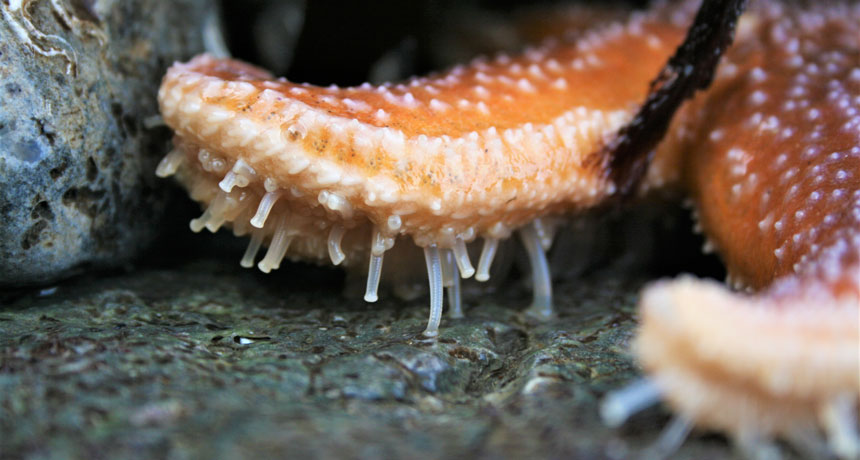
Sea stars and their relatives eat, breathe and scuttle around the seafloor with tiny tube feet. Now researchers have gotten their first-ever look at similar tentacle-like structures in an extinct group of these echinoderms.
It was suspected that the ancient marine invertebrates, called edrioasteroids, had tube feet. But a set of unusually well-preserved fossils from around 430 million years ago, described September 13 in Proceedings of the Royal Society B, provides proof.
Usually, when an echinoderm dies, “the tube feet are the first things that go,” says Colin Sumrall, a paleobiologist at the University of Tennessee, Knoxville who wasn’t part of the study. “The thing that’s so stunning is that they didn’t rot away.”
An abundance of soft-bodied creatures from the Silurian Period, which lasted from 444 million to 419 million years ago, are preserved in a fossil bed in Herefordshire, England. The edrioasteroids found in this bed were probably buried alive by volcanic ash, entrapped before their soft tissues could break down, says study coauthor Derek Briggs, a paleontologist at Yale University. Decaying tissue then left a void that was filled in by minerals, which preserved the shape of the appendages.
Briggs and his collaborators slowly ground three fossils down, taking pictures layer-by-layer to build up a three-dimensional view. The specimens are a new genus and species, the analysis revealed. Unlike relatively flat sea stars and sand dollars, the species — dubbed Heropyrgus disterminus — had a conical body about 3 centimeters long. Its narrower end anchored in the seabed. The other end sported a set of five plates partially covering dozens of tube feet arranged in a pentagonal ring.
Today’s echinoderms use hydraulic pressure in a water vascular system to extend and retract their tube feet, which serve a variety of roles. The feet can help animals pull in tiny particles of food, filter water or gases, and even inch along the seafloor. Based on the placement of H. disterminus’s tube feet (and the fact that it’s stuck in one place), the animal probably used the appendages mostly for feeding and gas exchange, Briggs suggests. The fossils didn’t preserve the internal tubing that hooks up to the tube feet, but Briggs’ team thinks that it’s a series of canals arranged like spokes connected to a wheel hub.
Sumrall isn’t surprised that this edrioasteroid had tube feet. “It’s exactly what we would have expected,” he says. But all other preserved tube feet to date come from classes of echinoderms that still have living relatives today. Edrioasteroids are less closely related to modern echinoderms, so this find broadens the range of species that scientists know sported the structures.
H. disterminus does have a few surprises, though: Its tube feet are found in two sets, in an arrangement not seen in any other echinoderms. And while it has five-point symmetry in its fleshy top part (like most other echinoderms), that transitions to eight-point symmetry in its long, columnar body.
Array