Warning: Array to string conversion in /home/www/www.sknl.cn/wp-content/plugins/wpjam-basic/public/wpjam-utils.php on line 496
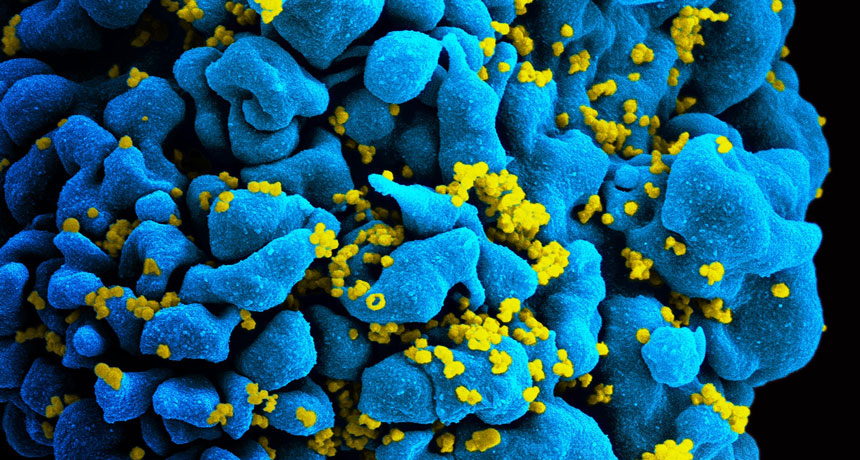
For certain HIV antibodies, having a buddy or two makes a big difference in the fight against the virus.
Combining the antibodies, called broadly neutralizing antibodies, may stop more strains of HIV than any single one can do alone, two new studies suggest. A “triple-threat” antibody molecule can bind to three different spots on the virus, researchers report online September 20 in Science. In Science Translational Medicine, a second team describes a cocktail of two single antibodies that each target a different region of the virus. Both methods prevented infection from multiple strains of an HIV-like virus in monkeys.
“We have known for many years that broadly neutralizing antibodies are extremely powerful antibodies,” says molecular biologist Nancy Haigwood of the Oregon Health & Science University in Portland, who was not involved in either study. Using more than one of these antibodies “is the most promising approach” to block HIV infection in humans because it offers more coverage, she says.
This extra coverage is needed because HIV is a master of mutation. “It’s really adopted every bit of what I would call molecular trickery to outwit our immune system, and it’s a constant battle,” says Gary Nabel, coauthor of the study in Science and chief scientific officer of Sanofi in Cambridge, Mass. The immune system keeps trying to recognize parts of the virus, but mutations in the virus can alter those sites. “You really want to have this broadside attack against the virus that hits multiple targets,” he says.
Broadly neutralizing antibodies are powerful because they can bind to multiple strains of HIV (SN: 8/19/17, p.7). The antibodies stop HIV from getting into cells to infect them. Still, “there is no single antibody” that can block all strains, says virologist Dan Barouch of Beth Israel Deaconess Medical Center in Boston.
Barouch and colleagues tackled the issue by mixing two of the antibodies together. The researchers divided 20 rhesus monkeys into four groups, giving one group the cocktail, two groups the individual antibodies and one group a saline solution with no antibodies. A day later, all of the monkeys were exposed to a mix of two simian-human immunodeficiency virus, or SHIV, strains. The outer protein that surrounds HIV, where antibodies bind, is the same in SHIV. None of the five animals that received the antibody cocktail became infected, while all of the other animals did, the researchers report in Science Translational Medicine.
Nabel and colleagues took a different tack: They developed a molecule that combines the binding talents of three antibodies into one. The researchers tested their “tri-specific” antibody in rhesus monkeys, giving eight animals the trio antibody while two other groups each received just one of the broadly neutralizing antibodies that inspired the molecule. The animals were exposed to a mix of SHIV strains five days later. Of the 16 monkeys in the solo antibody groups, 11 developed infections. None of the eight animals dosed with the trio antibody did.
Both teams’ antibody approaches “show impressive protection against a combination of viruses, suggesting that they would be effective” against diverse HIV strains in humans, Haigwood says.
Virologist David Margolis of the University of North Carolina School of Medicine in Chapel Hill notes that the approaches are most likely to have preventative potential, but they also may be therapeutic. The antibody combinations might “replace oral antiretroviral therapy, or stand in for oral therapy in medical situations where pills cannot be taken,” he says.
The next step for both methods is to test the combination antibodies in people, the authors say. Whether the strategy is most effective as a preventative measure, treatment or both, the papers suggest that “to achieve optimal protection in humans,” multiple antibodies or antibody targets are going to be needed, Barouch says.
Array