Warning: Array to string conversion in /home/www/www.sknl.cn/wp-content/plugins/wpjam-basic/public/wpjam-utils.php on line 496
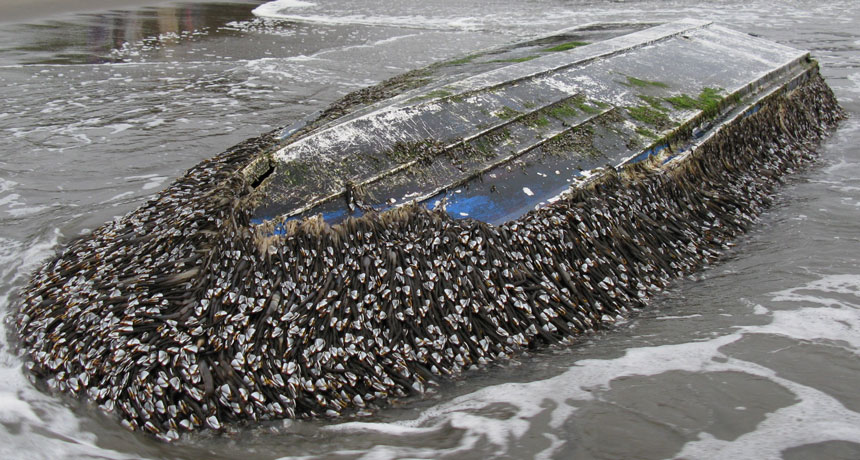
The 2011 tsunami that devastated Japan’s coast cast an enormous amount of debris out to sea — way out. Japanese marine life took advantage of the new floating real estate and booked a one-way trip to America. From 2012 to 2017, at least 289 living Japanese marine species washed up on the shores of North America and Hawaii, hitching rides on fishing boats, docks, buoys, crates and other nonbiodegradable objects, a team of U.S. researchers report in the Sept. 29 Science.
Organisms that surprisingly survived the harsh 7,000-kilometer journey across the Pacific Ocean on 634 items of tsunami debris ranged from 52-centimeter-long fish (a Western Pacific yellowtail amberjack) to microscopic single-celled protists. About 65 percent of the species have never been seen in North America’s Pacific waters. If these newcomers become established, they have the potential to become invasive, disrupting native marine habitats, says study coauthor James Carlton, a marine scientist at Williams College in Mystic, Conn.
Meet some of the slimiest, strangest and potentially most invasive marine castaways that took this incredible journey:
The Northern Pacific sea star (Asterias amurensis) is among the world’s most invasive species. Though this purple and yellow sea star is normally found in shallow habitats, it can live as deep as 200 meters.
Skeleton shrimp (Caprella cristibrachium and C. mutica (shown)) grasp onto algae with their strong rear claws, earning them the nickname “praying mantis of the sea.” These lanky amphipods can grow up to about 5 centimeters long and are found in the Sea of Japan.
A white, brittle Bryozoan (Biflustra grandicella) that can grow as big as a basketball is already invasive in Australia. The tiny swimming larvae of these sea creatures, also known as moss animals, may live up to a week, long enough to settle in to a new habitat.
Most of the wooden Japanese debris items collected carried at least one of seven species of large wormlike mollusks called Japanese shipworms (Psiloteredo sp.). Some of the more monstrous shipworms found, which bore into everything from wooden pilings to docks, had grown to about 50 centimeters long.
Five Japanese barred knifejaw fish (Oplegnathus fasciatus), also known as striped beakfish, were found trapped in the stern well of a Japanese fishing boat found beached in 2013 in Washington. These black-and-white striped fish are native to the Northwest Pacific Ocean and Hawaii. The well acted as a tide pool of sorts, sustaining the fish during their two-year journey.
The wavy-shelled slipper snail (Crepidula onyx), also known as a slipper limpet, has essentially come full circle in its journey around the Pacific Ocean. Native to the U.S. West Coast, the well-traveled snail became an invasive species in Japan, and now has returned to America on Japanese debris.
Array