Warning: Array to string conversion in /home/www/www.sknl.cn/wp-content/plugins/wpjam-basic/public/wpjam-utils.php on line 496
Chinese researchers have developed a multifunctional soft robot which is capable of operating in extremely cold environments and navigating complex structures, offering significant advantages in scenarios such as aero engine blisk inspection, slit detection, and operations in cold regions, Jiemian News reported on Thursday.
The robot, jointly developed by the Laboratory for Aerospace Structure Technology of the Northwestern Polytechnical University, the City University of Hong Kong and the Hong Kong Polytechnic University based on a new type of electroactive polymer, performed tasks such as autonomous heating, inspection and ice melting at temperatures as low as -50 C.
Electroactive polymers are smart materials that can change their size, shape or volume in response to a strong electrical field, and are widely used in cutting-edge fields such as artificial muscles and soft robotics.
As application scenarios expand, robots face higher demands for multifunctional integration capabilities. Conventional electroactive polymers usually can only change dimensions when electrically activated, limiting adaptability to different environments and integration needs. Developing smart materials with multi-mode responsive behaviors and achieving functional integration remains an urgent challenge in current soft robotics research.
In this study, the team has developed a vinyl acetate-enhanced electroactive polyvinyl chloride gel with low-voltage deformation, strong electro-adhesion, and controlled heating. Compared with existing materials, it reduces heat generation by over 50 percent, extends lifespan 15-fold, increases output force 1.75 times, and boosts electro-adhesion force 2.15 times, researchers said.
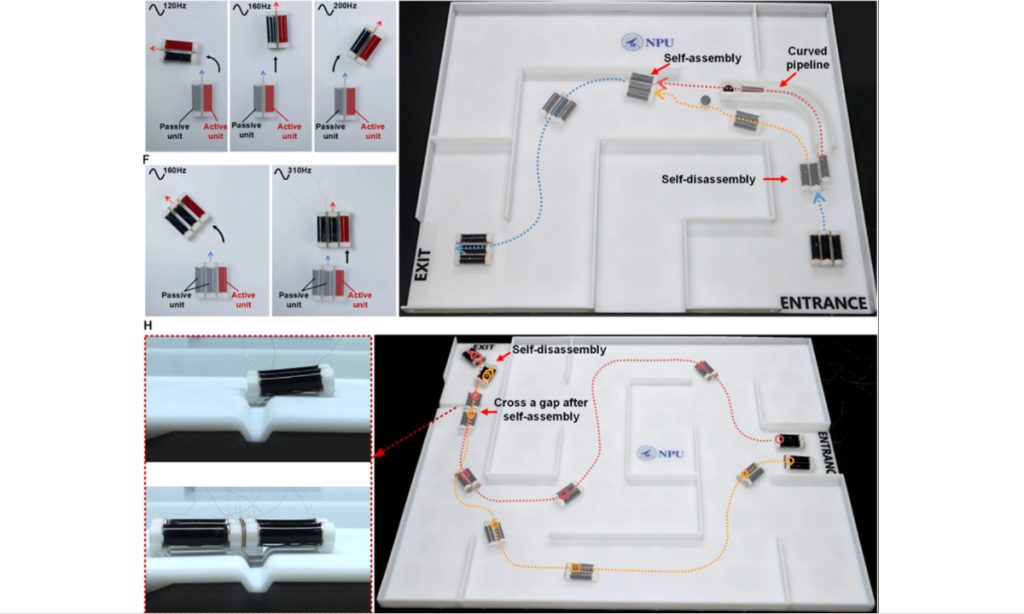
Using this improved material, the research team has developed a miniature soft robot capable of rapid crawling, self-heating in low-temperature, modular assembly and collaborative operation.
This robot’s compact structure and the advances in its actuation enable the robot to operate at ultra-low voltage (72.5 V), which demonstrates a 75 percent reduction in driving voltage relative to state-of-the-art systems.
Breakthroughs in electro-adhesion enable the self-reconfigurable robots to achieve module connections within millimeter dimensions without relying on complex microstructures.
The achievement of self-reconfiguration in robots with a dimensional limitation is expected to facilitate the advancement of robotic swarms.
In extreme cold environment, the robot completed self-heating, aero engine blisk inspection, and ice melting tasks at freezing temperatures, demonstrating clear advantages in application scenarios such as aero engine blisk inspection, slit detection, and cold-region operations.
The study provides new insights for the development of small intelligent robot systems in extreme environments and also demonstrate the broad application potential of such materials in fields including electronic devices, bionic systems, and intelligent manufacturing.
The research team mainly focuses on applications of the robot in high-end precision equipment, such as rapid inspection of aircraft engines used in polar regions. By optimizing the robot’s structural design, it can also be applied to inspection tasks of narrow pipelines encountered in everyday life, such as oil and gas pipelines or heating pipes, Zhang Junshi, a professor from Northwestern Polytechnical University, who led the research, told the Global Times on Thursday.
Some researchers in the team also proposed to apply this material to the medical and healthcare field. Owing to its softness and controllable deformation, it can be used in massage, physiotherapy, or in developing soft exoskeletons for assisted movement, making them lighter, more adaptable and safer than current rigid structures, according to Zhang.
The research findings were recently published on the international journal Advanced Science, according to a statement released by the Northwestern Polytechnical University.
Array