Warning: Array to string conversion in /home/www/www.sknl.cn/wp-content/plugins/wpjam-basic/public/wpjam-utils.php on line 496
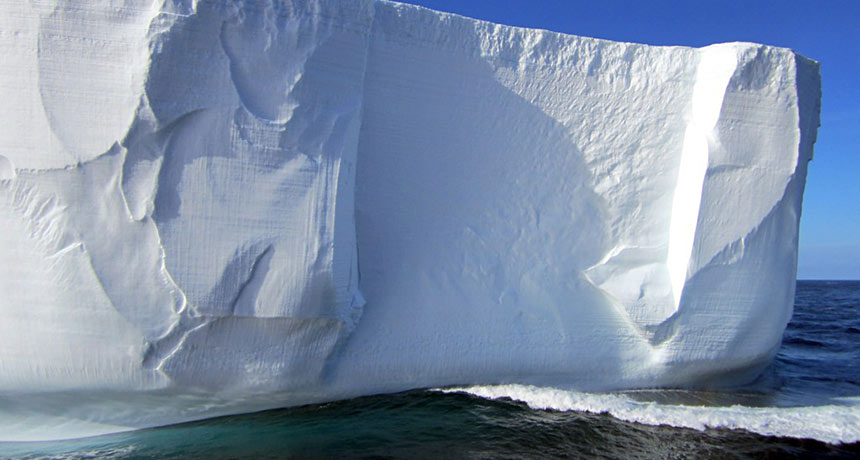
Just beyond the tip of the Antarctic Peninsula lies an iceberg graveyard.
There, in the Scotia Sea, many of the icebergs escaping from Antarctica begin to melt, depositing sediment from the continent that had been trapped in the ice onto the seafloor. Now, a team of researchers has embarked on a two-month expedition to excavate the deposited debris, hoping to discover secrets from the southernmost continent’s climatic past.
That hitchhiking sediment, the researchers say, can help piece together how Antarctica’s vast ice sheet has waxed and waned over millennia. And knowing how much the ice melted in some of those warmest periods, such as the Pliocene Epoch about 3 million years ago, may provide clues to the ice sheet’s future. That includes how quickly the ice may melt in today’s warming world and by how much, says paleoclimatologist Michael Weber of the University of Bonn in Germany.
Weber and Maureen Raymo, a paleoclimatologist at Lamont-Doherty Earth Observatory in Palisades, N.Y., are leading the expedition, which set sail on March 25.
“By looking at material carried by icebergs that calved off of the continent, we should be able to infer which sectors of the ice sheet were most unstable in the past,” Raymo says. “We can correlate the age and mineralogy of the ice-rafted debris to the bedrock in the section of Antarctica from which the bergs originated.”
Icebergs breaking off from the edges of Antarctica’s ice sheet tend to stay close to the continent, floating counterclockwise around the continent. But when the bergs reach the Weddell Sea, on the eastern side of the peninsula, they are shunted northward through a region known as Iceberg Alley toward warmer waters in the Scotia Sea.
Because so many icebergs from all around the continent converge in one region, it is the ideal place to collect sediment cores and take stock of the debris that the bergs have dropped over millions of years.
“That area in the Scotia Sea is so exciting, because it’s a focus point between South America and the Antarctic Peninsula where the currents flow through, and there are a lot of icebergs,” says Gerhard Kuhn, a marine geologist at the Alfred Wegener Institute in Bremerhaven, Germany. “You get a picture of more or less [all of] Antarctica in that area,” says Kuhn, who has studied the region but is not aboard the current cruise.
The expedition, known as leg 382 of the International Ocean Discovery Program, plans to drill at six different sites in the Scotia Sea. At three sites, the team plans to penetrate about 600 meters into the seafloor. “That would likely bring us back to the mid-Miocene, which could translate into 12 million to 18 million years back in time,” Weber says.
At another site, the team plans to drill even deeper, 900 meters, to go further back in time, in hopes of finding sediments that date to the opening of the Drake Passage about 41 million years ago. That passage, a body of water that now lies between South America and Antarctica, opened a link between the Atlantic and Pacific oceans and may have played a role in building up Antarctica’s ice sheets at different times in its history.
A graveyard turned crystal ball
How much a melting Antarctica might have contributed to global sea-level rise following the last great ice age, which ended about 19,000 years ago, has been a subject of debate. Seas rose by about 130 meters from 19,000 to 8,000 years ago, Weber says, and much of the melting happened in the northern hemisphere.
But Antarctica may have played a larger role than once thought. In a study published in Nature in 2014, Kuhn, Weber and other colleagues reported that ice-rafted debris from that time period, as recorded in relatively short sediment cores from Iceberg Alley, often occurred in large pulses lasting a few centuries to millennia. Those data suggested that the southernmost continent was shedding lots of bergs much more quickly during those times than once thought.
Now, the researchers want to see even further into the past, to understand how quickly Antarctica’s ice sheet might have melted during even warmer periods, and how much it may have contributed to episodes of past sea-level rise.
The new drilling expedition targets several periods when the climate is thought to have warmed dramatically. One is a warm period in the middle Pliocene about 3.3 million to 3 million years ago, when average global temperatures were 2 to 3 degrees warmer than today; another is the ending of an older ice age about 130,000 years ago, when sea levels rose by about 5 to 9 meters.
Such periods may serve as analogs to the continent’s future behavior due to anthropogenic global warming. Currently, global average temperatures on Earth are projected to increase by between about 1.5 degrees and 4 degrees Celsius relative to preindustrial times, depending on greenhouse gas emissions to the atmosphere over the next few decades (SN: 10/22/18, p. 18).
“The existing [ice core] record from Iceberg Alley taught us Antarctica lost ice through a threshold reaction,” Weber says. That means that when the continent reached a certain transition point, there was sudden and massive ice loss rather than just a slow, gradual melt.
“We have rather firm evidence that this threshold is passed once the ice sheet loses contact with the underlying ocean floor,” he says, adding that at that point, the shedding of ice becomes self-sustaining, and can go on for centuries. “With mounting evidence of recent ice-mass loss in many sectors of West Antarctica of a similar fashion, we need to be concerned that a new ice-mass loss event is already underway, and there is no stopping it.”
Array